
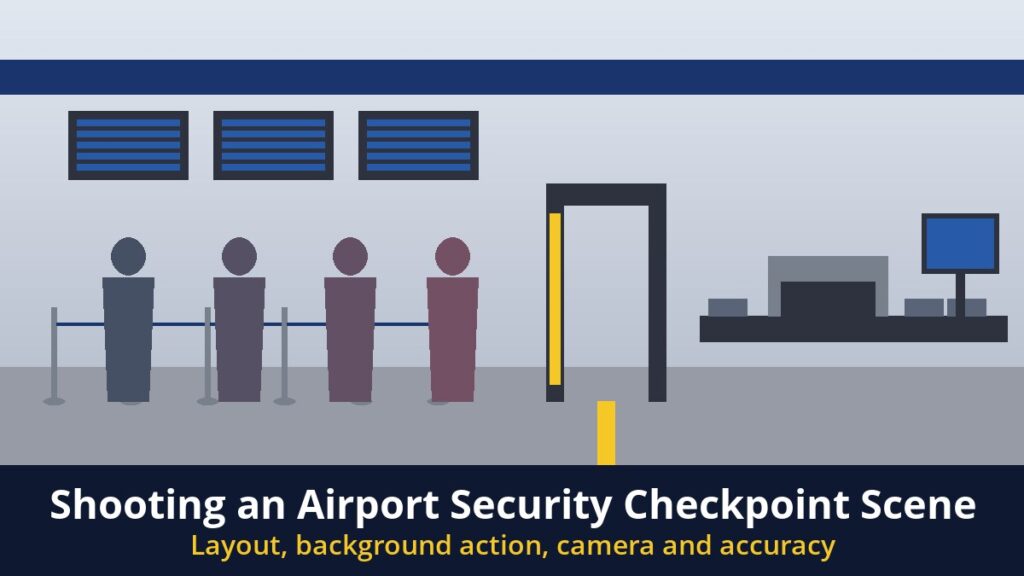
Airport security is one of the most recognizable settings in film and TV. The bins, the belt, the walk-through frame and the line of travelers waiting their turn instantly tell the audience where they are, and the checkpoint is a natural place for tension: a forgotten item, a suspicious bag, a character trying not to be noticed. It is also one of the hardest places to shoot for real. This guide covers how to plan an airport security checkpoint scene on a set, from layout and dressing to background action, camera and the details that make it believable.
Why Productions Build the Checkpoint Instead
A working checkpoint is one of the most controlled areas of any airport. Filming there generally involves permits, airport and security approvals, escorts and tight limits on where the camera can go and when, and passengers still need to get through. Even when access is granted, you cannot rearrange lanes, control the lighting or reset the scene for take after take. A security checkpoint set gives you all of that control, on your schedule.
Plan the Layout From the Story
Start with what the scene needs to show, then build the checkpoint around it:
- The queue. Stanchions and belts shape the line and give background performers a natural path. A long snaking line reads as a busy travel day; a short one reads as late night or early morning.
- The document check. A podium where an officer checks boarding passes and IDs is often the first beat of the scene.
- The screening lane. Bins, a loading table, the bag screening area and a walk-through frame are the heart of the checkpoint. Decide which side of the lane your main action happens on.
- The recompose area. Benches or tables after screening, where travelers put shoes and belts back on, are good for dialogue and reveals.
- The way out. Wayfinding signs toward the gates connect the checkpoint to the next scene.
Building It at Air Hollywood
Our airport terminal film set rents fully furnished with airport seating, arrival and departure monitors, TSA screening equipment, stanchions, signage and touchscreen kiosks. Double-sided rolling wild walls let us change the layout or color scheme quickly, and with included access to our prop house the terminal can be turned into a ticketing area, a security checkpoint, a departure lounge or customs and passport control. That means you can shoot check-in, security and the gate in one place, with the same crew and lighting package.
Background Action Makes or Breaks the Scene
A checkpoint feels real when everyone in it is doing something specific. Give your background performers clear tasks:
- Travelers emptying pockets, removing laptops and taking off shoes and jackets
- Someone repacking a bag at the recompose table
- A family with a stroller or a traveler in a hurry asking to cut the line
- Officers directing the line, checking documents and watching screens
Plan resets carefully. Bins, bags and belongings move every take, so assign a props person to return everything to its first position before each new take.
Camera and Coverage
- The wide. Establish the line, the lanes and the officers in one frame so the audience understands the space.
- Down the lane. A shot along the belt follows a bag or a character through screening and is ideal for building suspense.
- The screener’s view. A close-up of a monitor or an officer’s face reacting to it tells the audience something is wrong before the character knows.
- Inserts. Hands placing items in a bin, a bag stopping on the belt, a boarding pass under a scanner.
Wild walls give you room for wider lenses and dolly moves that would be impossible in a real terminal.
Lighting and Atmosphere
Airport checkpoints are usually lit with even, bright overhead light, so a flat, cool look feels authentic for most scenes. If the story needs tension, shift it with tighter framing and performance rather than dramatic lighting. Practical monitors and departure boards add movement and color in the background. For sound, record dialogue clean and add terminal ambience, announcements and belt noise in post.
Uniforms, Signs and Accuracy
Audiences know this space well, so small mistakes stand out. Many productions use generic or fictional uniforms, patches and signage rather than copying official insignia, and bring in a technical advisor to check procedure. Decide early how much detail the story needs: a comedy can exaggerate, while a thriller benefits from careful accuracy. For dressing, Air Hollywood Props rents terminal props, security props and airport signage.
Connect the Checkpoint to the Rest of the Trip
Security is usually one stop in a longer journey. After the checkpoint, move your characters to the gate in the same terminal and then onto a plane such as the Narrow-Body 737 or the Wide-Body 747. For the full picture, read our guides on filming an airplane scene without a real plane and planning a cockpit scene.
Frequently Asked Questions
Can you film at a real airport security checkpoint?
Working checkpoints are tightly controlled. Filming generally needs airport and security approvals, and access and camera positions are limited. Most productions build or rent a checkpoint set instead.
What equipment does a security checkpoint set need?
At a minimum: stanchions for the queue, a document check podium, bins and a loading table, a screening lane with a walk-through frame, monitors and signage. Our terminal set includes TSA screening equipment, stanchions, signage and monitors.
Can the same set be used for check-in and the gate?
Yes. Our airport terminal can be reconfigured as a ticketing area, a security checkpoint, a departure lounge or customs and passport control, so several airport scenes can be shot in one place.
How many background performers do I need?
It depends on the frame and the story. A few well-directed travelers can fill a tight shot, while a wide establishing shot of a busy checkpoint needs a fuller line. Plan the number around your widest angle.
Book a Scout
Walk the terminal with your director and production designer to plan the checkpoint layout. Call 747-400-0747 or contact Air Hollywood to schedule a scout at our studio at 27615 Avenue Hopkins, Valencia, CA 91355.
Related production guides
- How to Film an Airplane Scene Without a Real Plane
- Narrow-Body vs Wide-Body Airplane Sets: How to Choose
- How to Plan a Cockpit Scene for Film and TV
- What to Ask When Scouting an Aviation Studio
- Airplane Set vs Real Aircraft: Cost and Logistics for Filming
- Music Video Ideas on an Airplane Set
- How to Film a Private Jet Scene