
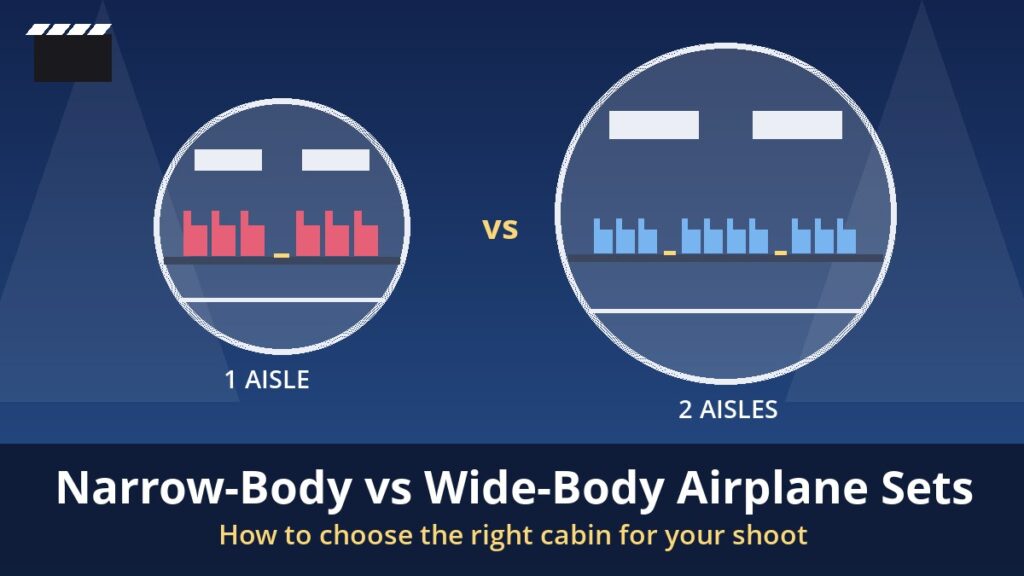
One of the first decisions on any airplane scene is the size of the aircraft. Is your character squeezed into a single-aisle commuter flight, or stretching out on a long-haul jumbo jet? The answer shapes the look of the scene, the way you block it, where the camera can go and which set you book. This guide explains the difference between narrow-body and wide-body airplane sets, what each one says on screen, and how to choose between them for a film, TV episode, commercial, music video or photo shoot.
Narrow-Body vs Wide-Body: The Basic Difference
In aviation, the terms describe the fuselage, and the quickest way to tell them apart on camera is the number of aisles.
- Narrow-body aircraft have a single aisle with seats on either side. Think of the 737 and 757 families that fly most short and medium-haul routes. Economy is usually three seats on each side of the aisle, and first or business class is two and two.
- Wide-body aircraft have two aisles and a wider cabin. The 747, 767 and 777 are classic examples. They fly long-haul routes and often have larger premium cabins, more galley space and, on the 747, an upper deck.
Audiences may not know the terminology, but they read the difference instantly. A single aisle feels close, busy and everyday. Two aisles and high ceilings feel like an international flight, a special occasion or a bygone era of luxury travel.
What Each Cabin Says on Screen
When a narrow-body set is the right call
Most present-day flight scenes take place on narrow-body aircraft, because that is what most people fly. Choose a narrow-body set when your script calls for:
- A domestic or short-haul flight, a commute or a business trip
- Tension and claustrophobia: a confrontation in the aisle, a passenger who can’t escape the seatmate, a thriller set-piece
- Comedy built on crowding, overhead bins and the drinks cart
- A modern, recognizable cabin for a commercial or brand spot
The single aisle also gives you a strong, simple visual line. A long lens down the aisle compresses rows of seats into a wall of passengers, which is one of the most familiar shots in airplane scenes.
When a wide-body set is the right call
Wide-body cabins tell the audience that this flight matters. They suit:
- Long-haul and international journeys, overnight flights and red-eyes
- Premium cabins: first class, business class, a lounge or a bar
- Period pieces set in the golden age of air travel, when the jumbo jet was the height of glamour
- Scenes with several groups of characters who need their own space in the same cabin
- Production design that needs depth: staircases, galleys and wider spaces that read in a wide shot
How Cabin Size Affects Blocking and Coverage
Beyond the look, the cabin you choose changes how a scene is shot.
- Blocking. A single aisle forces characters into a line, so entrances, exits and crosses all happen in one lane. Two aisles let you stage parallel action and give characters more ways to move through the cabin.
- Camera placement. In any airplane set, fly-away walls, ceiling panels and removable seats are what make coverage possible. Ask which pieces come out on the set you are considering, because that determines where you can put a dolly, a crane arm or a light.
- Background performers. A full narrow-body economy cabin needs a lot of extras to look busy. A premium wide-body cabin can look full with fewer people, because the seats are larger and further apart.
- Lighting. Practical window, ceiling and reading lights do much of the work in both cabin types. Color-corrected LED practicals make it easier to match day and night scenes.
Narrow-Body and Wide-Body Options at Air Hollywood
Air Hollywood has built aviation standing sets for productions since 1998, and the fleet covers both cabin types:
- Narrow-Body 737: a clean, modern interior with more than 60 feet of fuselage, first/business seating (2 x 2), a long economy cabin (3 x 3), front and rear galley/lavatory sections, color-corrected LED window and ceiling lights, fly-away walls and seats, and a steel platform capable of a turbulence effect.
- Narrow-Body 757: a real aircraft converted into a film set with more than 60 feet of fuselage. It is based in the New York City area and can be delivered and assembled at your location in one day.
- Wide-Body 747: a cabin with classic Pan Am-era styling and three spaces: the Main Deck First Class Cabin with walls that taper toward the nose, the Main Deck Business Class Cabin and the Upper Deck Lounge, reached by a winding central staircase. A fully equipped central galley lines up with the boarding doors. Because this cabin also hosts the Pan Am Experience events, check filming availability early.
- AutoPlane: a fully mobile, 53-foot airplane mockup that can be set up in a narrow-body or wide-body configuration and can be ready to roll in as little as 2 hours, with first and economy seating, fly-away walls and ceiling panels, and deployable oxygen masks.
- Alpha Mobile Truck Set: a 50-foot mobile set that expands to a narrow or wide body plane and is deliverable anywhere in North America.
If you only need a slice of cabin for window seats or close-ups, the 20-foot wall units are a lighter option: the 777 Mobile Wall and the 737 Double Wall, which has both an interior and an exterior face for shots through the window.
A Quick Decision Checklist
Run through these questions with your director, production designer and line producer before you scout:
- Where is the flight going? Short domestic hop points to narrow-body; long-haul or international points to wide-body.
- When is the story set? A present-day cabin and a 1970s jumbo jet need very different sets and dressing.
- Which cabin class? Economy-heavy scenes favor a long narrow-body cabin. First class, business class or a lounge favor a wide-body.
- How much of the cabin is in frame? If you only see a row or two, a wall unit may be enough.
- Where are you shooting? If you can’t come to Los Angeles, look at the mobile sets.
- What else happens on the journey? Plan the airport terminal, cockpit and lavatory scenes at the same time so the whole trip feels consistent.
Dressing Each Cabin Type
The right props sell the cabin size. A narrow-body economy cabin feels real with seatback items, carry-on bags, blankets and a drinks cart. A wide-body premium cabin calls for more generous service: glassware, menus, amenity kits and crew wardrobe that matches the era. Air Hollywood Props rents thousands of aviation-themed items, from in-flight service pieces to seats and wardrobe, so the set and the dressing come from one place.
Frequently Asked Questions
What is the difference between a narrow-body and a wide-body airplane set?
A narrow-body set recreates a single-aisle cabin like a 737 or 757, with seats on either side of one aisle. A wide-body set recreates a twin-aisle aircraft like a 747, with a wider cabin, bigger premium sections and, on the 747, an upper deck.
Which airplane set is best for a modern commercial flight scene?
For most present-day economy or business travel scenes, a modern narrow-body cabin such as our Narrow-Body 737 is the closest match to what audiences fly every day.
Can one set work as both a narrow-body and a wide-body cabin?
Yes. The AutoPlane and the Alpha Mobile Truck Set can each be configured as a narrow-body or wide-body cabin, which helps productions with several flight scenes or tight budgets.
Do I need a full fuselage for an airplane scene?
Not always. If the scene stays on one or two rows, a 20-foot wall unit can give you the window, seats and overhead panels in frame with a much smaller footprint.
Book a Scout
Still deciding between a narrow-body and a wide-body cabin? Walk both with your team before you lock the shooting plan. Call 747-400-0747 or contact Air Hollywood to schedule a scout at our studio at 27615 Avenue Hopkins, Valencia, CA 91355, or browse all of our airplane mockup rentals.