
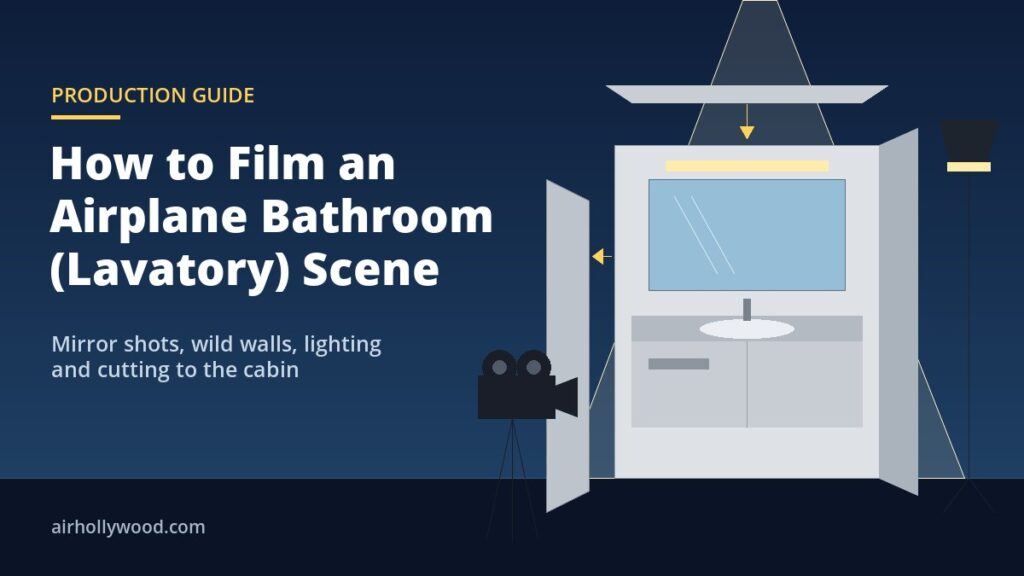
The airplane bathroom is one of the most useful small spaces in film and television. A character hides there, takes a secret phone call, has a panic attack in front of the mirror, delivers a punchline through a folding door or finds the clue that turns the plot. It is also one of the hardest spaces to shoot. A real aircraft lavatory is barely wider than a person, with a fixed ceiling, a mirror that reflects every light and lens, and nowhere to put a camera. This guide explains how to film an airplane lavatory scene on a set: how to plan the shots, light a tiny mirrored room, handle sound and water effects, and connect the bathroom to the rest of the cabin.
Why Airplane Bathroom Scenes Are Shot on a Set
Inside an airliner, the lavatory is a sealed module. You cannot remove a wall for a wider lens, raise the ceiling for a light, or pull the mirror out of the way of the camera reflection. A stand-alone lavatory set changes that. Air Hollywood’s Wild Lavatory 1 and Wild Lavatory 2 have wildable walls, ceilings and mirrors, which means each piece can be pulled away when a shot needs the room.
- Camera access. Remove a wall to shoot a wide profile, or keep it in and shoot through the door for a claustrophobic feel.
- Lighting access. Pull the ceiling to top-light the actor, then put it back for the reverse.
- Mirror control. Wild the mirror out to place the camera where the reflection would be.
- Placement. A stand-alone unit can be positioned on stage wherever the blocking needs it.
Plan the Scene Before You Scout
Lavatory scenes are short on screen but slow to shoot, because every setup changes which walls are in. Break the scene down before the scout:
- List the beats. Entering, locking the door, the mirror moment, the knock from outside, the exit. Each beat suggests a camera position.
- Decide what the audience sees. Is the scene about isolation (tight, close, ceiling in) or action (wider angles, walls out)?
- Mark the mirror shots. Any shot that sees the mirror needs its own plan for hiding the camera and the lights.
- Note what happens outside the door. A flight attendant, a line of passengers or turbulence in the aisle may need a cabin set as well.
- Group setups by wall. Shoot everything that needs the same wall removed together, so the grips are not rebuilding the room between every take.
Camera Angles That Work in a Tiny Room
The through-the-door shot
Shooting from the aisle through the open door keeps the audience outside with the other passengers. It is ideal for comedy reveals and for scenes where someone is caught in the act.
The mirror shot
The classic lavatory image is the character staring at their own reflection. With a wildable mirror you can remove the glass and shoot straight on from where the mirror was, or keep the mirror and angle the camera so the lens stays out of frame. Plan the eyeline with the actor either way.
The overhead and the tight close-up
With the ceiling out, a top shot shows just how cramped the space is. Tight close-ups with the walls in sell panic and claustrophobia. Mix both to give the edit a sense of the room without losing intimacy.
The two-person squeeze
When two characters share the lavatory, remove the wall that gives you the cleanest profile of both. Keep the door side intact so the knock from outside still plays.
Lighting a Lavatory Set
Real aircraft lavatories are lit by a single overhead or mirror light. That hard, flat look is part of what makes the space feel real, but it is rarely flattering. A few practical approaches:
- Keep a visible practical light source in frame so the look stays motivated.
- Use the open ceiling to add soft top light, then bring the ceiling back for wider shots.
- Watch reflections in the mirror and any glossy surfaces; flag lights and crew out of frame before every take.
- Decide early whether the scene is calm, tense or comic, and set the color temperature to match.
Sound, Turbulence and Water Effects
Most lavatory dialogue is quiet and close, which is good news on a stage: the set is not running engines. Record clean dialogue and add cabin ambience, the flush, the lock and the “return to your seat” announcement in post. If the scene includes turbulence, handle the shake with camera movement and the actors’ performance, and keep any rigging approved by the studio.
The plumbing in Air Hollywood’s lavatory sets no longer works, but some clients have rigged the units for special water effects. If your scene needs running water, a splash or a flood gag, raise it at the scout so your effects team and the studio can agree on the approach.
Connect the Bathroom to the Cabin
A lavatory scene almost always starts or ends in the aisle. Plan the transition so the cut feels continuous:
- Pair the lavatory with the Narrow-Body 737 for an economy-class story, or the Wide-Body 747 for a larger cabin with premium sections.
- Match the door, lighting color and sound between the two spaces.
- Use two lavatory units side by side to recreate the bank of restrooms found on a real aircraft, or pre-light one unit while shooting in the other.
- Browse all of our aviation sets if the story moves on to the cockpit or the airport.
Dressing the Lavatory
Small details sell the scene: signage, hand towel and tissue dispensers, a trash flap, a call button, toiletries, and the personal items your character brings in. Air Hollywood Props rents aviation props and set dressing that can be added to any set, so you can browse the prop house and build a dressing list before the scout. If the story uses a fictional airline, carry its branding into the lavatory signage and amenities.
Lavatory Scene Checklist
- Break the scene into beats and mark every mirror shot.
- Choose one or two lavatory units.
- Choose the cabin set the scene cuts to.
- Group setups by which walls, ceiling or mirror come out.
- Plan lighting that stays motivated by a practical source.
- Agree on any water or turbulence effects at the scout.
- Make a dressing list and reserve props.
- Plan ambience, announcements and Foley for post.
Frequently Asked Questions
Can I film an airplane bathroom scene without a real aircraft?
Yes. Air Hollywood has two stand-alone airplane lavatory sets, Wild Lavatory 1 and Wild Lavatory 2, with wildable walls, ceilings and mirrors for flexible camera and lighting setups.
How do you hide the camera in a mirror shot?
On a set with a wildable mirror, you can remove the mirror and shoot from its position, or keep it and angle the camera and lights so they stay out of the reflection.
Does the plumbing work on the lavatory sets?
No. The plumbing is not functional, but some clients have rigged the units for special water effects. Discuss your effects plan with the studio before the shoot.
Can I combine the lavatory with a cabin set?
Yes. The lavatory sets are commonly paired with cabin sets such as the Narrow-Body 737 or Wide-Body 747 so the scene can cut naturally between the restroom and the aisle.
Book a Scout
Ready to plan your airplane bathroom scene? Call 747-400-0747 or contact Air Hollywood to schedule a scout at our studio at 27615 Avenue Hopkins, Valencia, CA 91355, and see all of our aviation sets.