
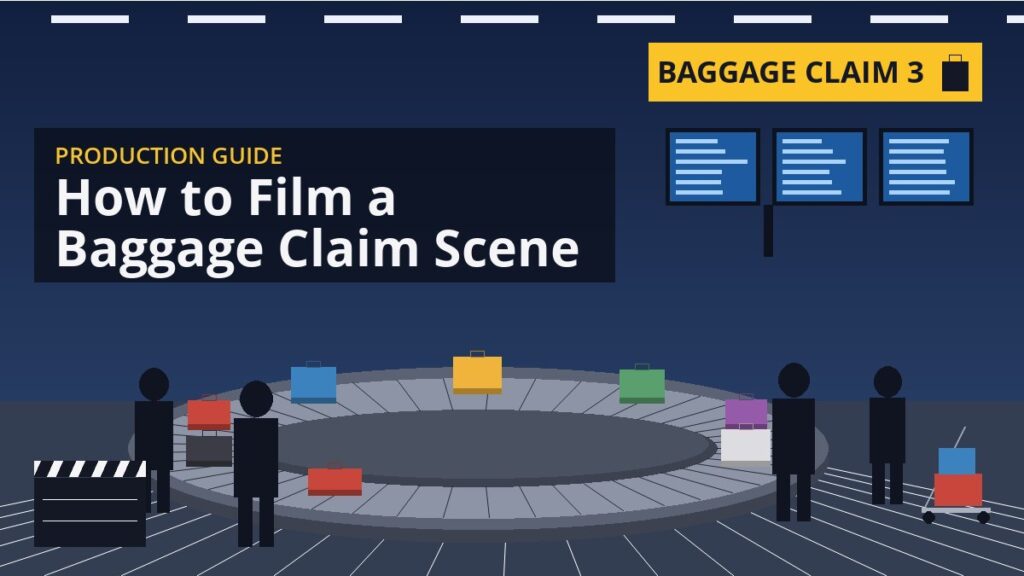
Baggage claim is where airport stories land. It is the reunion after a long separation, the traveler watching the belt empty while their suitcase never appears, the stranger who grabs the wrong bag and sets a plot in motion. Audiences recognize the space instantly, which makes it a useful shorthand for “they have arrived.” This guide covers how to film a baggage claim scene on a set: what the space needs, how to handle the carousel, which props sell it, and how to block and cover the moments that usually happen there.
Why Shoot Baggage Claim on a Set
At a working airport, baggage claim is busy from the first arrival of the day to the last. Real passengers need the belts, announcements interrupt takes, and you have no control over the signage, the airline names on the monitors or the crowd moving through your frame. Filming there typically means permits, escorts and limited hours, and you still cannot reset a carousel full of luggage for take two.
A set turns those problems into choices. You decide which city the arrivals hall belongs to, what the monitors say, how many travelers wait at the belt and exactly when the hero bag appears. You can repeat the reunion as many times as the scene needs, and you can light the space for the mood of the story instead of the fluorescent reality of a real terminal.
What a Baggage Claim Scene Needs
Most baggage claim scenes are built from the same few elements. Knowing which ones your script actually uses lets the art department spend the budget where the camera will look.
The carousel or belt
This is the signature piece and the most demanding one. If the scene centers on a bag coming around, the belt needs to read clearly in the frame. If the belt is only background, you can often suggest it rather than show it in full (see the next section).
Signage and arrival monitors
An overhead “Arrivals” or “Baggage Claim” sign and a wall of arrival monitors tell the audience where they are within a second. Monitors are also storytelling tools: a flight listed as arrived, a delayed connection or a belt number gives the viewer context without a line of dialogue.
Luggage and carts
Volume sells the space. A believable claim area needs far more luggage than the cast will ever touch, in a mix of sizes, colors and wear, plus luggage carts and the kiosks that hold them. The hero bag should be easy to pick out on camera without looking out of place.
The meeting point
Reunion scenes usually happen at the edge of the claim area, where waiting friends and drivers stand. Stanchions, a seating bank, a pay phone or a charging station help define that edge and give background players something natural to do.
Faking the Carousel
A full working carousel is a large, specialized build, and many scenes do not need one. Before committing to it, look at what the camera actually has to see:
- Tight on the belt. A short run of belt framed close, with bags sliding into frame from off-screen, can carry an insert or a close-up of a character watching. The rest of the room is implied by sound and the reverse angle.
- Background only. If the scene is a conversation near the belt, the carousel can sit soft in the background, with extras lifting bags from it to suggest movement.
- Static belt, moving people. For many moments the belt does not need to move at all. Travelers crowding the edge and pulling bags off do most of the work.
- Visual effects extension. A practical foreground with a green screen behind it lets post-production add a longer hall and more belts.
Settle this early with your production designer, and ask during your scout what can be built or dressed for the belt on the stage you are considering.
Props That Sell an Arrivals Hall
Air Hollywood Props rents the terminal pieces that make a claim area read as real, including:
- Luggage carts in short and tall styles, plus matching cart kiosks
- Modern luggage and pilot or briefcase-style luggage
- Arrivals/departures monitor walls in two-monitor, four-monitor and tower styles
- Hanging “Arrivals” signs and directional wall signs
- Stanchions, terminal seating, pay phones, courtesy phones and charging stations
Mix in personal luggage from the cast and background wardrobe so the belt does not look like a matched set. Tags, straps and stickers on a few bags add life in close-ups, but keep real airline names and logos off anything the camera can read.
Blocking the Moments
The wait
Waiting is the heart of most baggage claim scenes. Give the character something to watch and something to do: checking a phone, scanning the monitors, edging closer to the belt as it starts. Background players arriving in waves, collecting bags and leaving keep the room alive and make the hero’s wait feel longer.
The reunion
Plan the geography first. Decide where the arriving character enters the hall, where the person waiting stands and the line between them. A clear path lets the camera find both faces before they meet, and stanchions or a seating bank can hold the crowd so the moment has room to land.
The missing or wrong bag
The empty belt is a classic beat: the crowd thins, the last bags circle and the character is left alone. Plan background departures carefully so the room empties at the right pace. For a wrong-bag mix-up, use two identical hero bags and make sure the audience sees both before the swap.
Coverage and Camera
- Establish with the signage. A wide that includes the arrivals sign or monitor wall places the scene immediately.
- Let the belt lead the eye. Panning with a bag as it travels creates movement and tension even in a quiet moment.
- Go low on the belt. Low angles make luggage feel larger and the wait more dramatic.
- Shoot through the crowd for reunions so the meeting builds as people clear.
- Get inserts of tags, handles and the hero bag for the edit.
Building the Arrivals Sequence at Air Hollywood
Air Hollywood’s Airport Terminal film set is designed to change roles. It rents fully furnished with airport seating, arrival and departure monitors, stanchions, signage and touchscreen kiosks, plus double-sided rolling wild walls for quick changes to layout or color scheme. With access to the prop house, the terminal can be dressed as ticketing, a security checkpoint, a departure lounge or an arrivals area.
Baggage claim rarely stands alone. It usually follows the flight and often follows passport control. You can shoot the in-flight scenes on our Narrow-Body 737 or Wide-Body 747 cabin sets, then move into the terminal for the arrival without a company move. For international arrivals, see our guide on filming a customs and passport control scene, and for the other end of the trip read how to film an airport gate and boarding scene. You can also browse all of our aviation sets.
Frequently Asked Questions
Can Air Hollywood’s terminal be dressed as baggage claim?
Yes. The Airport Terminal set is built to change roles and can be dressed with props from the prop house, including luggage, luggage carts, arrival monitors and signage, to play an arrivals area. Ask about the belt your scene needs when you book a scout.
Do I need a working carousel?
Not always. Many scenes work with a short section of belt framed tightly, a static belt with active background players, or a practical foreground extended with visual effects. Decide based on how much of the belt the camera has to see.
Where can I rent luggage and luggage carts for an airport scene?
Air Hollywood Props rents luggage, short and tall luggage carts with cart kiosks, arrivals/departures monitor walls, signage and stanchions, for use on the terminal set or at your own location.
Can I film the flight and the arrival in one place?
Yes. Air Hollywood has both airplane cabin sets and the Airport Terminal set at its studio, so the flight, passport control and baggage claim can be shot in one location.
Book a Scout
Planning a baggage claim or arrivals scene? Call 747-400-0747 or contact Air Hollywood to schedule a scout at our studio at 27615 Avenue Hopkins, Valencia, CA 91355, and walk the terminal with your director, production designer and director of photography.