
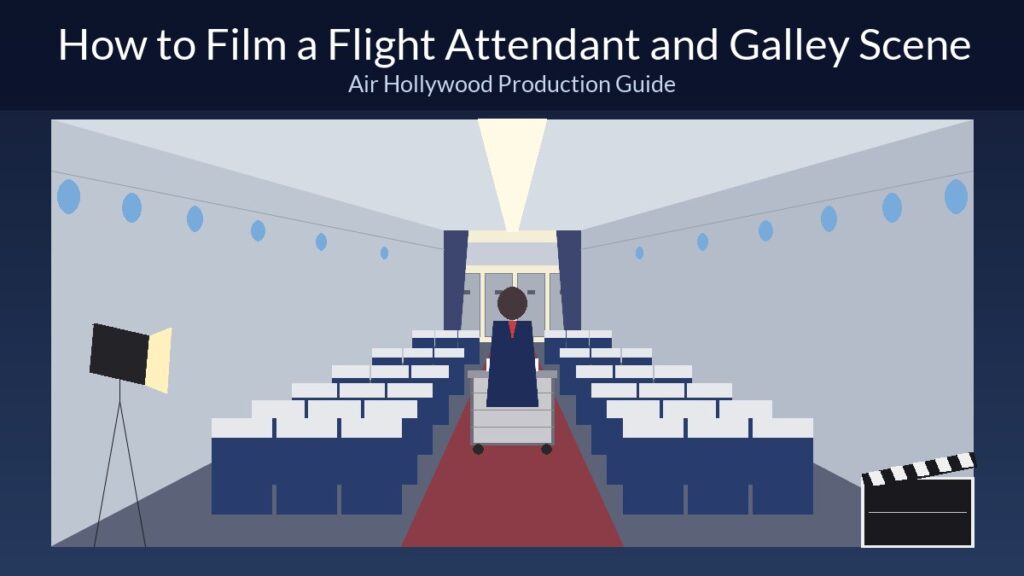
Flight attendants are often the quiet engine of an airplane scene. They greet passengers at the door, push the service down the aisle, calm a nervous flyer, catch a whispered secret in the galley and deliver the safety briefing that sets the tone for everything that follows. Getting these moments right on screen depends on two things: a cabin that behaves like a real working aircraft, and a plan for the galley, the aisle and the props before the first day of shooting. This guide covers how to film a flight attendant scene on an airplane set, from choosing the right cabin to blocking the service, lighting the galley and dressing the crew.
Why Flight Attendant Scenes Need a Working Set
A flight attendant scene is a scene about movement and routine. Crew walk the aisle, reach into overhead bins, answer call buttons, prepare drinks and trade lines in the galley between tasks. On a real parked aircraft, every one of those moves happens in a narrow tube with fixed walls, so the camera is always fighting for space and the lighting has nowhere to go.
A purpose-built airplane set solves that. Air Hollywood’s Narrow-Body 737 has front and rear galley/lavatory sections, a first/business class (2 x 2) and a long economy cabin (3 x 3), practical window and ceiling lights, and fully functioning reading lights and flight attendant call buttons. Its walls, ceiling panels, seats and galleys fly away, so the crew can open the cabin for a dolly, a light or a wider lens and then close it again for the reverse.
Choosing the Right Cabin and Galley
Modern narrow-body service
For present-day economy and business class service, the Narrow-Body 737 is the go-to set, with a clean, modern interior and galleys at both ends of the cabin. On the East Coast, the Narrow-Body 757 offers a similar layout with front and rear galley/lavatory sections and more than 60 feet of fuselage. It is based in the New York City area and can be delivered and assembled at your location in just one day.
Wide-body and premium cabins
If the story lives in first class or on a long-haul flight, the Wide-Body 747 has three cabins: the Main Deck First Class Cabin or “A Zone” where the walls taper toward the nose, the Main Deck Business Class Cabin, and the Upper Deck Lounge. Its central galley is fully equipped and aligned with the boarding doors, which makes it a natural hub for scenes that move between boarding, service and crew conversation.
Shooting on your own stage
When the production needs the cabin at its own stage or location, the AutoPlane mobile set brings 53 feet of modern airplane interior, first class and economy seating options, front and rear galley/lavatory scenery, and a LiteGear tungsten/daylight LED lighting system with DMX board.
Still deciding between layouts? Our guide to narrow-body vs wide-body airplane sets compares the options, or you can browse all of our aviation sets.
Plan the Scene Around the Crew’s Routine
Real cabin crew follow a predictable sequence, and audiences recognize it even if they could not describe it. Building your scene on that sequence makes it feel authentic and gives the actors clear business to play.
- Boarding. Greeting passengers at the door, checking boarding passes, helping with bags. This pairs naturally with a gate scene; see our guide on how to film an airport gate and boarding scene.
- Safety demonstration. Seatbelt, oxygen mask and exits, delivered from the aisle while passengers half listen.
- Service. Drinks and meals from the cart, working down the aisle row by row.
- Galley downtime. The private space where crew talk, argue, gossip or plan, out of sight of passengers.
- Call buttons and problems. A passenger who needs help, a medical moment, an unruly flyer or a tense discovery.
- Descent. Collecting trays, checking seatbelts, taking the jump seat for landing.
Most scripts only need two or three of these beats, but knowing where yours sits tells the art department how to dress the galley and background.
Blocking the Galley
The galley is the one place on an airplane where flight attendants can drop the professional smile, which is why so many dramatic and comedic exchanges happen there. It is also small, so blocking matters.
- Use the curtain or bulkhead. A partially open curtain lets you frame the galley conversation with passengers soft in the background, or play a reveal when someone walks in.
- Give the actors tasks. Stocking a cart, pouring drinks or preparing a tray keeps hands busy and makes overlapping dialogue feel natural.
- Plan your reverses early. On a set with fly-away walls, decide at the scout which panels come out for each angle, so the crew can turn around quickly.
Shooting the Aisle Service
Service scenes are about rhythm. A cart moving down the aisle, the stop at each row and the exchange with a passenger give you a natural structure for dialogue and coverage.
- Wide down the aisle. Establishes the cabin, the cart and the passengers; it is also the shot that reveals any continuity problems, so set background action carefully.
- Over-the-shoulder from the seat. Puts the audience in the passenger’s point of view as the flight attendant leans in.
- From behind the cart. Keeps the flight attendant in the foreground and the cabin stretching away behind them.
- Inserts. Pouring, handing over a tray, a hand on a call button, a seatbelt sign turning on.
Rehearse the cart timing with background extras so every visible row is doing something believable.
Lighting the Cabin and Galley
Practical window and ceiling lights, reading lights and call buttons give you motivated sources that read as part of the airplane. The galley can be lit a touch brighter and cooler than the cabin to separate the working space from the passenger space, which also helps the audience understand where they are. For a night flight, dim the cabin and let reading lights and the galley glow carry the scene. On a set with DMX lighting control, such as the AutoPlane, lighting cues can be repeated exactly from take to take.
Dressing the Crew and the Galley
Wardrobe and props sell a flight attendant scene as much as the set does. Think about the era and airline style of your story, and avoid real airline logos and liveries unless you have clearance. Plan the galley dressing so it matches the moment in the flight: tidy and stocked at boarding, busy during service, cluttered at the end.
Air Hollywood Props rents aviation props, in-flight service items, signage and crew wardrobe that can be added to any set. Browse the prop house and build a dressing list before your scout, including duplicates of anything that will be poured, spilled or handed over on every take. If your story is set in the golden age of air travel, our guide to filming a 1960s or 1970s period airplane scene covers period dressing in more detail.
Sound and Continuity
Record clean dialogue on the day and add the airplane in post: engine hum, cart wheels, the call button chime, galley clatter and cabin announcements. Capture room tone in the cabin and in the galley separately. Watch continuity on drinks, trays and cart contents, since service scenes are shot out of order.
Frequently Asked Questions
Which airplane sets have a galley for filming?
Air Hollywood’s Narrow-Body 737 and Narrow-Body 757 have front and rear galley/lavatory sections, the Wide-Body 747 has a fully equipped central galley aligned with the boarding doors, and the AutoPlane mobile set has front and rear galley/lavatory scenery.
Do the call buttons and reading lights work?
Yes. The Narrow-Body 737 and 757 sets have fully functioning reading lights and flight attendant call buttons, which add believable detail to service scenes.
Can I get flight attendant wardrobe and service props?
Yes. Air Hollywood Props rents aviation props, in-flight service items, signage and crew wardrobe that can be used to dress any of the sets.
Can the camera fit in the galley?
The 737 set has fly-away walls, ceiling panels, seats and galleys, so the crew can open up the space for camera and lighting access. Walk your angles at the scout to plan which pieces to move.
Book a Scout
Ready to plan your flight attendant or galley scene? Call 747-400-0747 or contact Air Hollywood to schedule a scout at our studio at 27615 Avenue Hopkins, Valencia, CA 91355, and see all of our aviation sets.